

Figures impressively illustrate Strength of German Automotive Industry
Market Leader and Innovation Driver
Electric car market leader in Europe – market share significantly expanded – Germany second largest production location for electric cars worldwide – every second electric car in Europe from German manufacturer
The German automotive industry is not only more successful with electric cars than is often reported, it is also the market leader for electric cars in Europe. Considering the year 2025, the market shares of German OEMs show that they often have even higher shares in the electric car market than in the overall market. This applies not only to the EU, but also to the USA, Canada, South Korea, and Japan, among others.
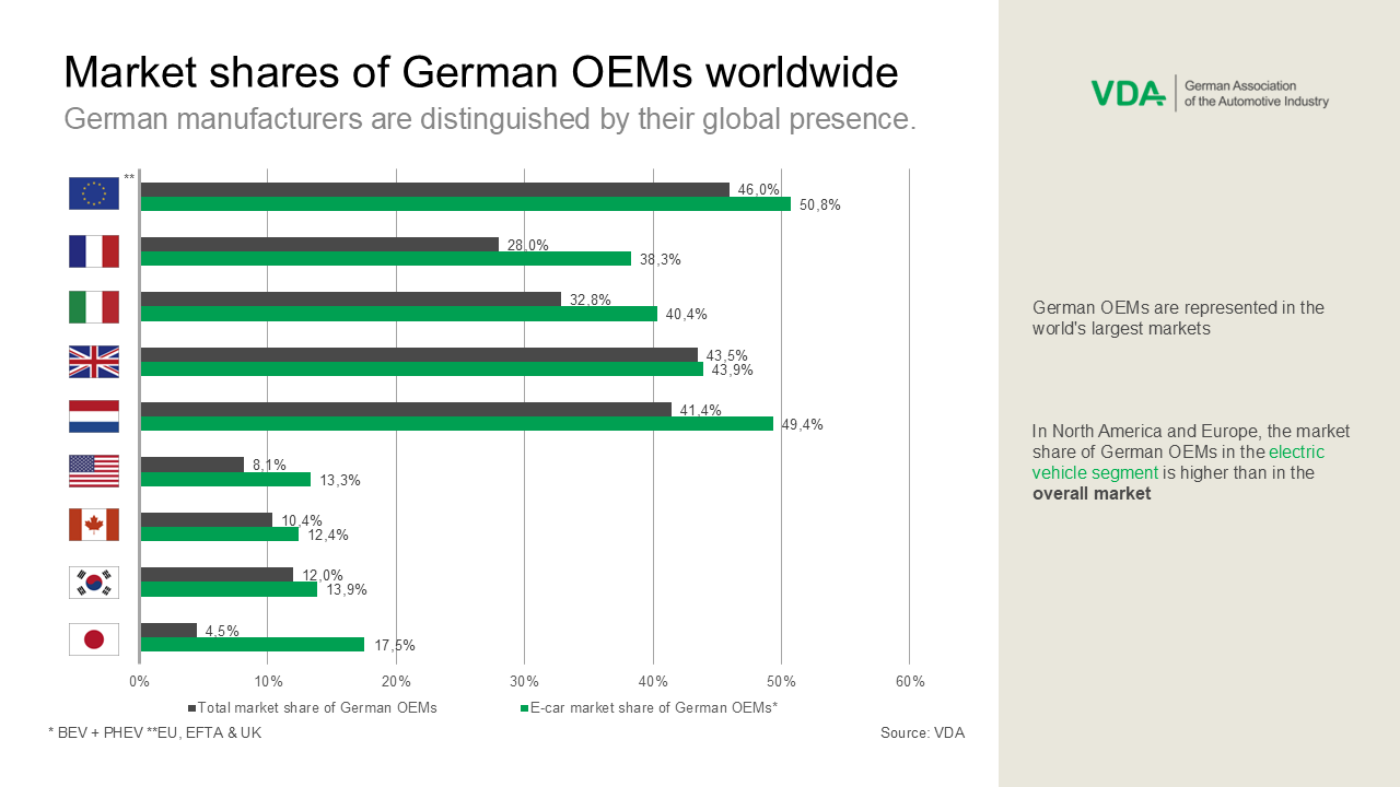
VDA President Hildegard Müller explains: "Too often, debates and arguments fall into black-and-white categories. The fact is: Our industry is restructuring, and we are investing with great commitment and creativity in innovations on the path to climate-neutral and digital mobility of the future. In many markets. Our manufacturers have a higher market share in e-mobility than in the overall market."
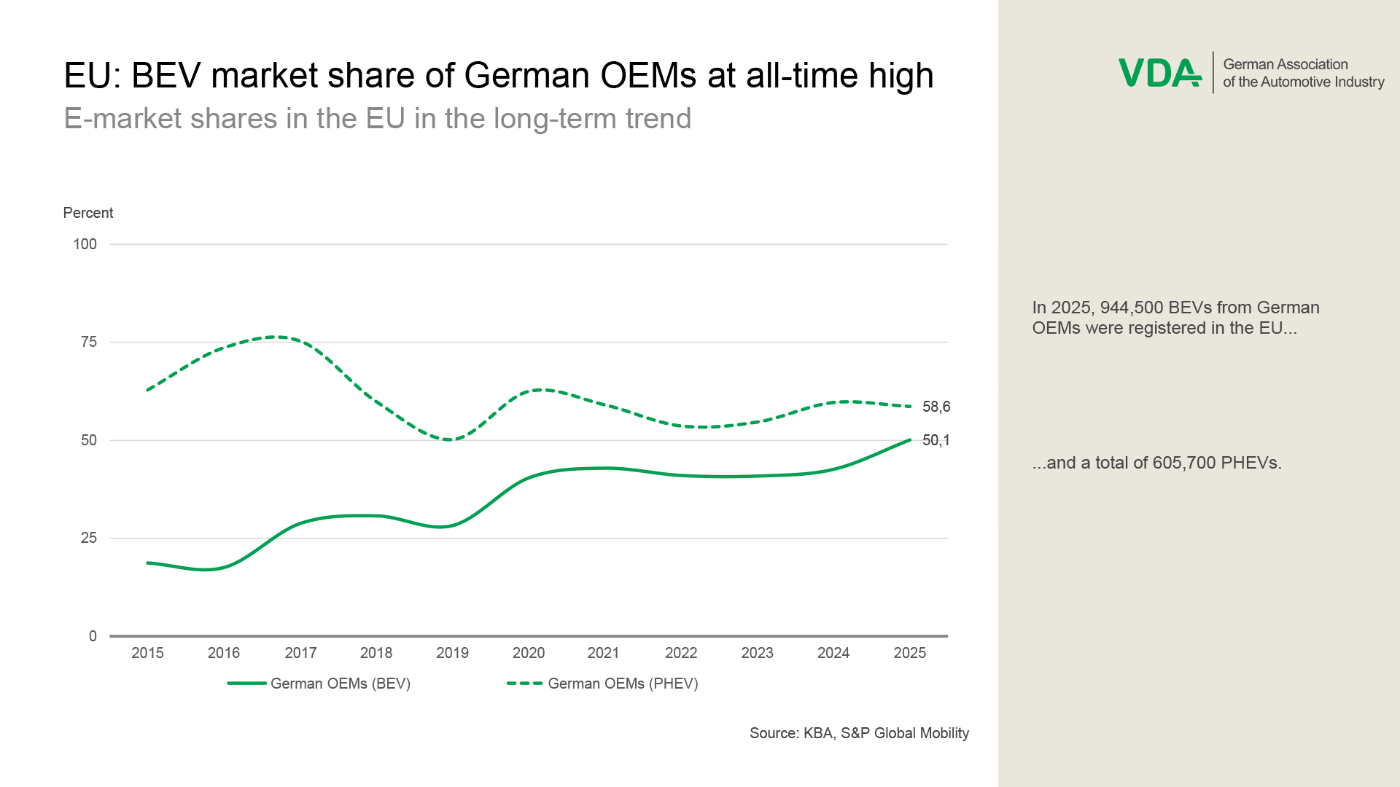
BEV market share of German OEMs at all-time high
How successfully the German automotive industry, both manufacturers and suppliers, is managing the transformation is also shown by further concrete figures from the past year:
- In Europe, currently around every second newly registered electric car comes from a German manufacturer.
- Seven out of ten new electric cars registered in Germany are from a German manufacturer.
- In 2025, more than 1.5mn electric cars from German OEMs have been registered in the EU.
- The ten most frequently registered electric car models in Germany in 2025 are all from German manufacturers and group brands.
- Germany is the world's second-largest production location for electric cars (after China, ahead of the USA). In Europe, nowhere are more electric cars produced than in Germany.
- German manufacturers even increased their market share in Europe in 2025.
- The innovative strength of our industry is also impressively demonstrated by figures from the German Patent and Trade Mark Office (DPMA): The top ten companies with the most patent applications in 2025 were all from the automotive industry.
- Our industry – manufacturers and suppliers – is also at the forefront when it comes to investments: around €320bn alone from 2026 to 2030 in R&D and a further €220bn in the conversion of plants.
Automotive industry has done its homework – politicians are under pressure to act
"Both our manufacturers and suppliers are globally positioned, invest heavily, and rise to the challenges. We build some of the best cars in the world now and will continue to do so in the future. The only question is increasingly what role Germany as a location can still play in this. That's why we repeatedly and emphatically address the lack of international competitiveness in Germany and the missing framework conditions, for example, regarding charging infrastructure or energy prices. We want to continue this success story here in Germany – and that will only work if these challenges are recognized and tackled proactively," Müller explained.
The daily headlines about job cuts and relocations are primarily the consequence of a misguided policy of regulations, requirements, and a lack of international competitiveness of the location.
"The belief that politics can make better economic decisions or better assess technological developments than companies, which have been doing so successfully for decades, has also failed. Now it is crucial to initiate a decisive and comprehensive course correction," Müller said.
Above all, she demands a clear and honest inventory with the corresponding conclusions:
"When it comes to the competitiveness of our location and the necessary decisions, looking at the figures, data and facts helps:
In all rankings that deal with factors such as energy costs, tax burden, bureaucratic effort, or labor costs, Germany has recently fallen far behind. We are facing a massive economic crisis affecting the entire German industry. The mandate for action for Brussels and Berlin is therefore clear."
Contact
Communications, Events & Marketing
Simon Schütz
Head of Department